
Chatham Hills Market Update: Westfield, IN Luxury Real Estate Trends – August 2026Chatham Hills continues to set the pace for luxury real estate in Westfield, IN. Based on 76 recent

Dated: June 13 2024
Views: 85

If you’ve seen the news lately about home sellers slashing prices, it’s a great example of how headlines do more to terrify than clarify. Here’s what’s really happening with prices.
The bottom line is home prices are higher than they were a year ago at this time, and they’re expected to keep rising, just at a slower pace.
But a recent article from Redfin notes,
“Price Drops Hit Highest Level in 18 Months As High Rates Dampen Buyer Demand.”
And that might make you think prices are declining.
Now, while it’s true the latest report from Realtor.com also shows 16.6% of homes on the market had price reductions in May, which is up from 12.7% last May, that doesn’t mean overall home prices are falling.
The key is knowing the difference between the asking price and the sold price.
In essence, the asking price, also known as a listing price, is the amount a seller hopes to get for their home when they list it. In reality, sellers can’t just put any price tag on their house and expect it to sell for top dollar. Today’s buyers are savvy customers, and when they aren’t willing to pay a premium for a home because their budgets are strained by higher mortgage rates, sellers need to adjust. And that’s what’s happening right now.
Based on market factors and what offers that seller receives, that asking price can change. If a seller isn’t getting much foot traffic, you may see them revise the price and make an adjustment to reignite interest in the home – and sometimes that’s because they’ve overpriced it from the start. That’s where price reductions come in, and when you see “price drops” in a headline, it sounds like declining home prices.
Mike Simonsen, CEO and Founder of Altos Research, says:
“Not only is the share of homes with price cuts elevated compared to one year ago, but more price cuts are happening each week than last year.”
On the other hand, the final sold price is the amount a buyer actually pays when the transaction is complete.
Here’s the most important thing to note: Actual sold prices are still rising, and they’re expected to continue to do so at least over the next 5 years.
So, while there's been an increase in price reductions recently, this doesn't mean overall home values are declining. Instead, it’s a sign that demand is moderating. And, as a result, sellers are adjusting their expectations to align with today's market reality.
Even with more price reductions, home values are still growing on an annual basis, as they do nearly every year in the housing market. According to the Federal Housing Finance Agency (FHFA), home prices went up 6.6% over the last year (see below):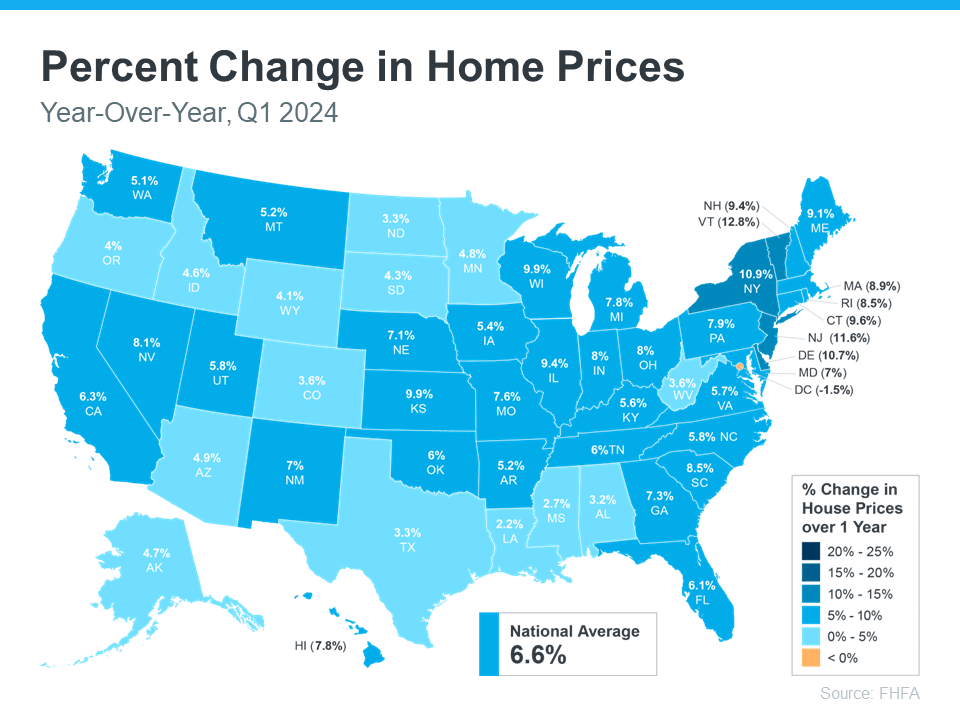
This map shows how prices rose just about everywhere in the country, indicating the market is not in decline.
So, while seller price reductions are often a leading indicator that prices may moderate in the months ahead, which experts have been saying for a while is expected to happen, they aren’t necessarily reason for alarm. The same article from Redfin also states:
“. . .those metrics suggest sale-price growth could soften in the coming months as persistently high mortgage rates turn off homebuyers. For now, the median-home sale price is up 4.3% year over year to another record high. . .”
And with inventory as tight as it is today, price moderation is much more likely in upcoming months than price declines.
For buyers, more realistic asking prices mean a better chance of securing a home at a fair price. It also means you can enter the market with more confidence, knowing prices are stabilizing rather than continuing to skyrocket.
For sellers, understanding the need to adjust your asking price can lead to faster sales and fewer price negotiations. Setting a realistic price from the start can attract more serious buyers and lead to smoother transactions.
While the uptick in price reductions might seem troubling, it’s not a cause for concern. It reflects a market adjusting to new conditions. Home prices are continuing to grow, just at a more moderate pace.

In the world of Real Estate, there are those who simply facilitate transactions, and then there are those who go above and beyond to make a profound impact on the lives of their clients. Meet Jason Ju....
Chatham Hills Market Update: Westfield, IN Luxury Real Estate Trends – August 2026Chatham Hills continues to set the pace for luxury real estate in Westfield, IN. Based on 76 recent
If you're watching the housing market in Carmel, Westfield, Zionsville, or Noblesville, Indiana, the numbers are in for June 2026 — and they tell a clear story: this remains one of the,
If you've been thinking about selling in Westfield, IN | Carmel, IN | Noblesville,IN | Zionsville, IN, you've probably seen plenty of headlines suggesting buyers have just about disappeared. But
Let me ask you something, and I want you to sit with it for a second before you answer.Think about the people you’re in business with right now. Your broker. The agents in your office. The
Additional:
600 E. Carmel Drive Suite 270Should you require assistance in navigating our website or searching for real estate, please contact our offices at 888-611-3912.

 MIBOR REALTOR® Association All information deemed reliable but not guaranteed. All properties are subject to prior sale, change or withdrawal. Neither listing broker(s) or information provider(s) shall be responsible for any typographical errors, misinformation, misprints and shall be held totally harmless. Listing(s) information is provided for consumer's personal, non-commercial use and may not be used for any purpose other than to identify prospective properties consumers may be interested in purchasing. The data relating to real estate for sale on this website comes in part from the Internet Data Exchange program of the Multiple Listing Service. Real estate listings held by brokerage firms other than eXp Realty in Metropolitan Indianapolis may be marked with the Internet Data Exchange logo and detailed information about those properties will include the name of the listing broker(s) when required by the MLS. Copyright ©2026 All rights reserved.
Last Updated: September 24, 2026 12:56 PM UTC
MIBOR REALTOR® Association All information deemed reliable but not guaranteed. All properties are subject to prior sale, change or withdrawal. Neither listing broker(s) or information provider(s) shall be responsible for any typographical errors, misinformation, misprints and shall be held totally harmless. Listing(s) information is provided for consumer's personal, non-commercial use and may not be used for any purpose other than to identify prospective properties consumers may be interested in purchasing. The data relating to real estate for sale on this website comes in part from the Internet Data Exchange program of the Multiple Listing Service. Real estate listings held by brokerage firms other than eXp Realty in Metropolitan Indianapolis may be marked with the Internet Data Exchange logo and detailed information about those properties will include the name of the listing broker(s) when required by the MLS. Copyright ©2026 All rights reserved.
Last Updated: September 24, 2026 12:56 PM UTC
33. Required DMCA Notice
The Digital Millennium Copyright Act of 1998, 17 U.S.C. §512, the DMCA, provides recourse for copyright owners who believe that material appearing on the Internet infringes their rights under U.S. copyright law. If you believe in good faith that any content or material made available in connection with our website or services infringes your copyright, you (or your agent) may send us a notice requesting that the content or material be removed, or access to it blocked. Notices must be sent in writing by email to DMCAnotice@MLSGrid.com. The DMCA requires that your notice of alleged copyright infringement include the following information: (1) description of the copyrighted work that is the subject of claimed infringement; (2) description of the alleged infringing content and information sufficient to permit us to locate the content; (3) contact information for you, including your address, telephone number and email address; (4) a statement by you that you have a good faith belief that the content in the manner complained of is not authorized by the copyright owner, or its agent, or by the operation of any law; (5) a statement by you, signed under penalty of perjury, that the information in the notification is accurate and that you have the authority to enforce the copyrights that are claimed to be infringed; and (6) a physical or electronic signature of the copyright owner or a person authorized to act on the copyright owners behalf. Failure to include all of the above information may result in the delay of the processing of your complaint.
